
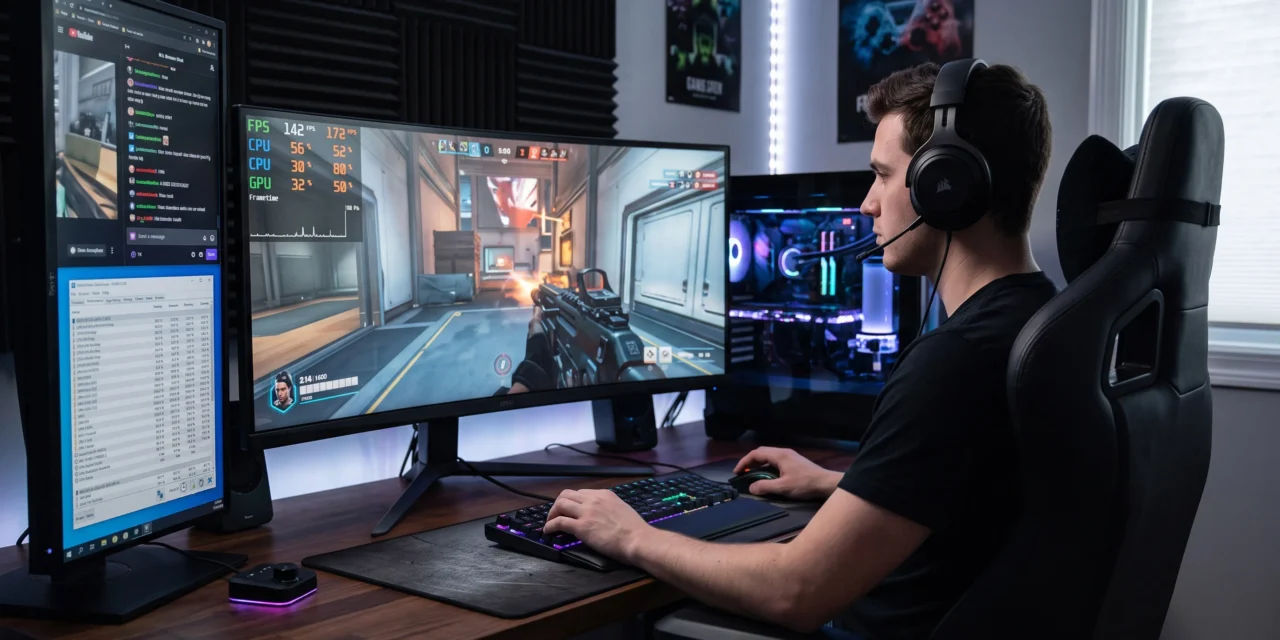
Modern video games are not just for entertainment. They have become a competitive environment, a professional industry that can rival traditional sports. In esports, it is not only the results and mechanical skills of the player that matter, but also the analysis of statistical indicators and data. Today, match results, team ratings, individual statistics and user behaviour are analysed in such detail that it changes the very approach to the game. Performance metrics allow us to evaluate progress and predict the development of esports.
The Role of Performance Metrics in Competitive Gaming
In competitive video games, performance metrics have become the basis for player and team development. They are used by coaches, analysts, and even gamers themselves to identify strengths and weaknesses. Accuracy analysis, KDA, economic efficiency, average damage per round, and other parameters play an important role in training.
This is especially noticeable in disciplines such as Counter-Strike 2 and Dota 2, where every player’s action is recorded by the server. Analysis of positioning, utility usage, creep stats, or GPM allows coaches to create detailed match preparation plans. It can be said that performance metrics have replaced the intuitive approach with statistical data, allowing esports to reach a new level.
It is worth noting that statistics help not only professionals. Regular players also use performance metrics to improve their own skills. Replay analytics technologies allow you to view your own matches, evaluate and correct errors. This allows players to train effectively and makes gaming more professional.
Data Analytics and Player Improvement
Data analytics has become one of the main drivers of individual player progress. If earlier training consisted simply of a large number of matches and training exercises, now they are based on the analysis of specific indicators. For example, low headshot percentage signals the need to improve aiming skills, and high death rate signals the need to improve positional play.
In modern team shooters or MOBA projects, performance metrics analysis helps develop personal training programmes. Players can determine which maps they have a higher win rate on, or in which roles they perform best. This is especially important in complex team disciplines such as Dota 2, where even small changes in macro decision-making can affect the outcome of a match.
The role of statistical platforms is worth noting. They collect data from thousands of matches, creating a basis for comparison, which facilitates cs2 predictions and allows you to assess the real level of professional teams. For example, analysing average damage or farm efficiency allows you to understand the strengths of a team and how well they are playing in the current patch.
Another important aspect is psychological. Data helps to avoid subjective assessments. Players may underestimate or overestimate their own game, so objective statistics reduce the impact of emotions and give a clear understanding of progress.
Impact on Esports Strategy and Team Management
In professional esports, teams build strategies around performance metrics. The analytics departments of large organisations operate almost like sports laboratories, researching opponents’ trends and creating counter-strategies.
Coaches use a range of tools to identify their players’ strengths and build the best strategy. In addition, performance metrics allow them to predict an opponent’s behaviour on a specific map. For example, if a team often attacks one area after losing a pistol round, this can be predicted and adjustments made to the strategy.
Developers of esports disciplines are actively developing statistics tools inside their video games, which allows teams to get even more information. Collecting telemetry data helps you understand which balance changes affect meta and which remain almost invisible. This is useful both for the competitive component and for keeping the game interesting and relevant.
Management also depends on performance metrics. The signing of new players, replacements in the composition or change of roles are based on analytical reports. In addition, statistics are used to plan the performance calendar. The training process is configured for the main tournaments so that the players approach them in the best shape.
Performance Metrics Beyond Competition: Casual Gaming and Industry Growth
Performance metrics are not only important in esports disciplines. They affect the entire video game industry — from matchmaking to the development of new mechanics. Developers analyse huge amounts of data to determine which maps or modes are popular. If most users leave the game after a certain level, this is a sign of problems with balance or complexity. In this way, performance metrics help identify problem areas and improve them.
Monetization also depends to a certain extent on analytics. Based on the study of player behavior, developers create events or battle pass that really interest the audience. Players receive interesting content, and developers make millions of profits. In free-to-play video games, this is critical for online support.
Casual players benefit from achievement and progression systems. Tracking statistics encourages them to improve their skills and take on new challenges. Even in story-driven projects, detailed progress summaries are becoming increasingly common, demonstrating the importance of statistics even in ordinary video games.
In addition, performance metrics are used in the fight against fraud. Anti-cheat systems analyze abnormal response or accuracy indicators, determining suspicious behavior. It helps to maintain an honest environment for the whole community.
Conclusion
Putting all the facts together, we can say that performance metrics are an important part of modern video gaming. They are used to develop professional teams, players, video game balance, and even the industry’s business model. Statistical analysis allows you to transform the chaotic process of gaming into a structured system of learning and strategic planning. That is why understanding performance metrics today is not just an additional option, but an advantage for anyone who wants to remain competitive in the gaming industry.